← All posts · SEO writing
SEO Writing May Seem Scary… But It’s Still One of the Most Sought-After Writing Skills
I’ve worked with several writers in my mentorship program, and one of the most popular requests I’ve received is: Teach me how to do SEO writing.
SEO used to be one of my most dreaded writing nemeses—until I found the secrets to gaming it. Now, I scale through SurferSEO tasks and even teach my writer friends how they can strategically beat the SurferSEO algorithm.
If you don’t know SurferSEO, this means you still have so much to learn about SEO writing, and you’ve not even scratched the surface of the types of clients you can attract. 🤯
Don’t fret. Pace yourself.
I share all the secrets in this post. Sit tight.
The Big Secret? I Changed My Perspective
First things first: Contrary to popular opinion, SEO ≠ stuffing a bunch of keywords into your article to make it rank on Google.
That’s another thing entirely called “keyword stuffing.”
I’m not going to lie…in the beginning, that was what I used to do. I could cram up to 10 keywords into 500 words until the article started to read robotic, even before AI writing became a thing.
Thankfully, with help from industry leaders like Neil Patel, I realized my errors. Now, I ghostwrite SEO articles for clients who keep coming back every month. Why? Because my method works, and the articles I deliver rank 😀.
Here are examples of articles that ranked on the first and third pages of Google when I originally shared this post:

So, what really is SEO writing?
SEO = Search Engine Optimization.
Simply put, it is optimizing your article to perform well on search engines like Google, Bing, Yahoo, etc.
SEO is about creating valuable user-centric content that aligns with search queries (things you search for online). The secret to SEO writing isn’t technical manipulation; it’s serving your reader.
Here’s What I Did (and You Can Do It Too)
Steal my framework:
I Started Using Keywords Strategically
Using the right keywords is how my readers find my posts and better understand the subject I’m discussing. You can’t write effectively and comprehensively about a keyword in your topic without mentioning it and related words multiple times in the article.
A few ways I incorporate keywords:
- I use keywords in the headlines so that my readers can understand the content before reading it.
- I use them in my headings to make my content skimmable.
- I add them to my meta descriptions, so readers can decide on the search engine page if my articles have what they need. And it usually does.
All the above focuses on helping my readers, but guess what? It also makes my articles accessible to search engines so they can suggest my posts to the relevant users.
I Wrote Quality, Comprehensive Content
Remember, the key to SEO still remains serving your readers. So, I started paying a lot more attention to creating quality, comprehensive content.
This is how I made this happen:
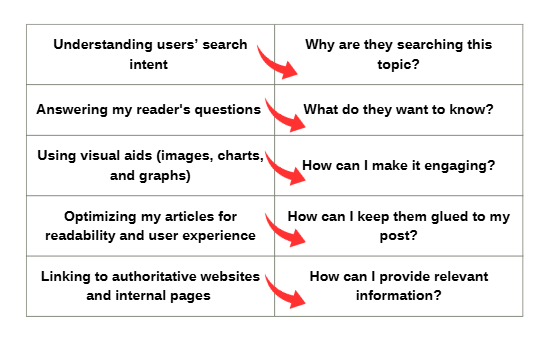
- Understand users’ search intent: Why are they searching this topic?
- Answer my readers’ questions: What do they want to know?
- Use visual aids: How can I make it engaging?
- Optimize for readability and user experience: How can I keep them glued to my post?
- Link to authoritative websites and internal pages: How can I provide relevant information?
The result?
- Readers left my page with their questions fully answered.
- The external links endorsed my content credibility.
- The internal links helped readers discover more of my content.
- My SEO ranking improved.
I Optimized My Content for Featured Snippets
Have you ever typed a question on Google and got a direct answer to your search query? Something like this:
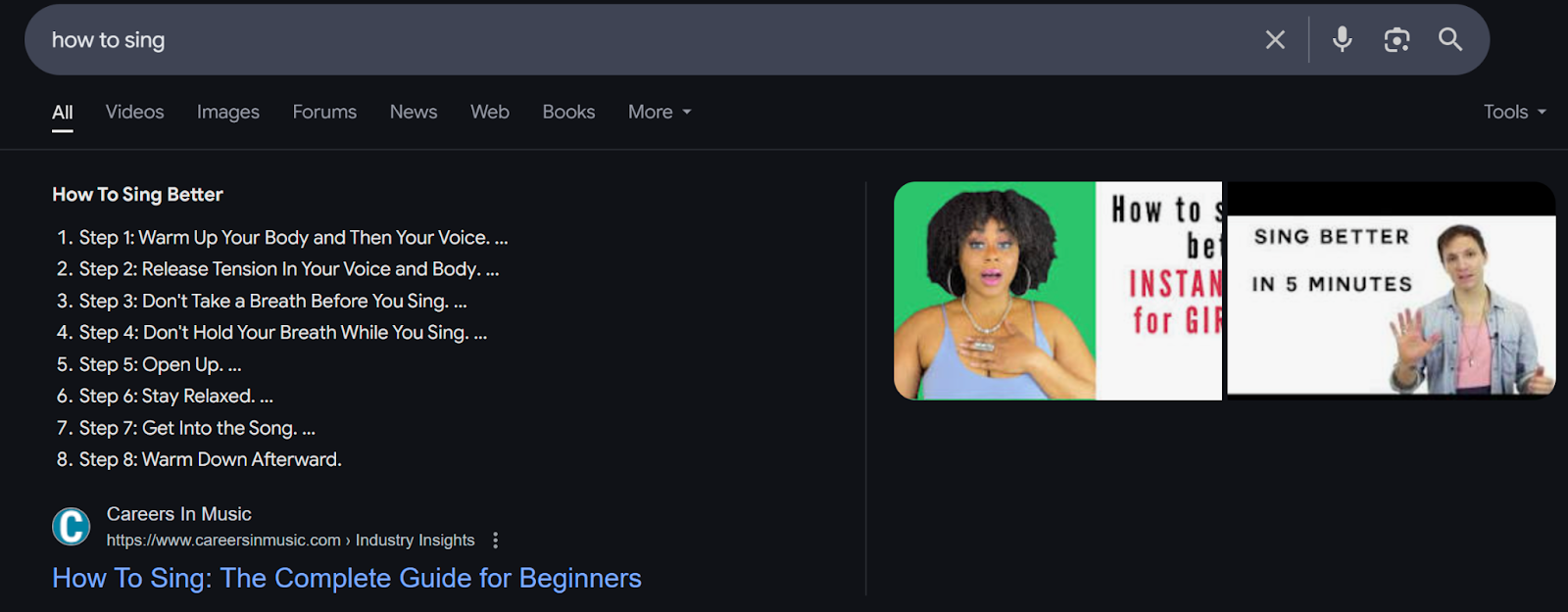
Getting an answer without clicking on any post was a relief, right?
This “short answer” is called a featured snippet. Google can use it to display an answer to a query. It’s a great way to save your reader time while appearing on the search engine page. Here’s how you can structure your content for it:
Use the question as a subheading (H2).
For example, if you’re writing about the effects of retinol on your skin, you can create a subheading that says, “How do you use retinol on your skin?” and then answer the question in 50–70 words.
Start the answer with the question.
Using the example above, the first line in this H2 would be, “You use retinol on your skin…”
Format your content so that Google can easily extract the answer.
You can achieve this by using numbers, steps, or bullet points.
Use actionable verbs like “click,” “apply,” and “remove” that indicate a guideline.
If you read this post to the end, it’s your lucky day because you now have a clear blueprint for mastering SEO writing. The best thing about these tips is that you can start working with them right away!
Get Writing Clarity
If there’s one thing I know about writers, they always have questions—no offense, it’s how we’re wired. This is why I’m always so excited about my Career Clarity sessions. I help writers like you get unstuck in the loop of whys and hows of content writing.
For 45 minutes, I’m all yours, helping you break down questions you have about writing in a detailed and easy-to-understand way.
If this sounds like something you need, take the next step now: book a clarity session.
Till next time. ✌️
If you have questions, I’m always eager to answer! You can email me, it’s delivered right into my inbox. Or you can shoot me a DM, whatever works.